Rescue teams in Nepal found a Chinese hydropower worker and a Nepali woman alive on Saturday, September 5, 10 days after catastrophic floods and mudslides struck the Himalayan country. Both survivors were recovered in separate operations as authorities continued searching for thousands of missing people.
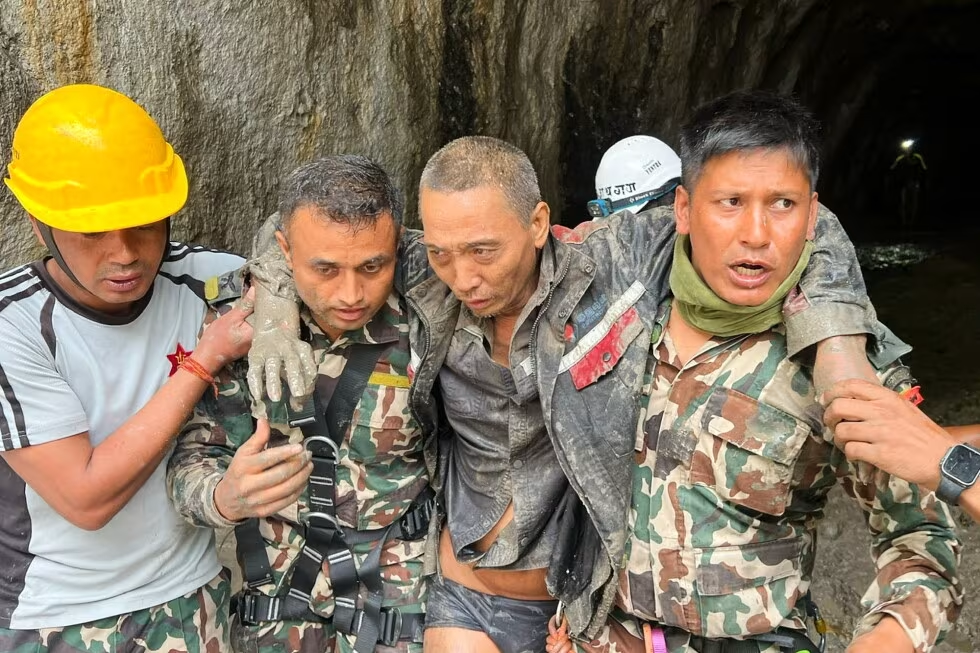
The Chinese national, identified as Lu Haitao, was pulled from a 225-metre tunnel at the Upper Trishuli-1 Hydropower Project in Rasuwa district. A joint team of Nepal Army personnel and South Korean disaster experts carried out the operation.
Lu had no visible injuries and his vital signs were stable, according to the Nepal Army. Medical workers detected mild hypothermia, and he was taken by helicopter to an army hospital for further examination.
Images released after the operation showed rescuers carrying Lu from the tunnel. Video from the helicopter showed a military medic checking him with a stethoscope while he appeared exhausted and covered in dried mud and dust.
Lu said he had repeatedly called out when he saw lights used by rescue crews, but they initially could not hear him. He said, ‘When they rescued me today, when they shone (the light) before my eyes, I couldn’t believe it.’
Woman rescued from flooded home
In a separate operation, soldiers rescued Chandika Kumari Shrestha from her home in Betrawati in Nuwakot district. Reports identified her as a 64-year-old Nepali woman.
Army images showed Shrestha covered in mud inside a damaged and flooded structure. Rescuers gave her bottled water before wrapping her in a grey blanket and moving her to safety.
She was airlifted to Kathmandu for treatment. Authorities did not immediately release detailed information about her injuries or how she survived for 10 days inside the damaged building.
Earlier tunnel rescue
The two recoveries came one day after rescuers pulled two Nepali workers alive from another tunnel at the Upper Trishuli 3A Hydropower Station. The men had been trapped for nine days behind mud, rocks and other debris.
The workers were identified as Sanjay Shah and Kabir Maharjan. They were found about 170 metres inside the tunnel and flown to a hospital in Kathmandu after being brought out early on Friday.
The latest tunnel rescue made Lu the third worker recovered alive from hydropower tunnels since Friday. Search teams said the survival of the workers had renewed attention on underground sections where other employees may still be trapped.
Flood began with mountain collapse
The disaster struck on the morning of August 26 after a large mass of glacier ice, rock and earth collapsed in the high Himalayas near the Nepal-China border. The falling material generated a fast-moving flood and debris flow that travelled through river valleys with little warning.
Satellite images taken before and after the event showed a major section of bedrock and glacier breaking away. The flood then moved through settlements along the river system, destroying homes, roads, schools, bridges and hydropower facilities.
The European Space Agency said the event was linked to a rapid slope failure associated with a glacier collapse on Langtang Lirung in Langtang National Park. The impact of the collapsing material produced seismic energy comparable to a magnitude 5.2 earthquake.
Rasuwa, Nuwakot and nearby districts were among the worst-affected areas. Roads were cut, electricity supplies were disrupted and several communities became difficult to reach because bridges and transport links had been washed away.
Thousands remain missing
Nepal’s disaster management authorities reported at least 1,344 deaths as of Friday. About 4,887 people remained missing, including 583 foreign nationals, many of them workers, pilgrims and trekkers.
The disaster also affected the Tibetan side of the border. Chinese authorities had reported 31 deaths and 531 missing people in Tibet by September 4.
Search operations have increasingly focused on 12 hydropower projects. About 900 workers connected to those sites remain unaccounted for, while authorities believe roughly 500 may be trapped in tunnels.
The entrances to several tunnels were blocked by deep mud, large boulders and damaged construction material. Floodwater and unstable ground have also created risks for rescue teams attempting to reach underground chambers.
Families have gathered at emergency centres and military facilities to provide photographs and information about missing relatives. Posters showing missing workers have been placed on walls at the Maithili Barrack in Nuwakot district.
Among those waiting for information is Krishna Poudel, whose brother Ishwor worked at the Hakubesi Hydroelectric Project. Krishna said he last spoke to Ishwor on August 26, after the flood entered the valley and trapped him inside a tunnel.
Krishna said, ‘I spoke to him at 7:30 a.m. before he went into the tunnel for work. Around 11:30 a.m., after the floods came down, I finally got through and he told me: ‘I’m trapped inside the tunnel.”
He said workers who escaped from the site later reported hearing the voices of people who remained underground. No further contact with Ishwor had been established by Saturday.
International teams join operation
Nepali soldiers, police officers and disaster-response personnel are leading the search. Specialist teams from India, China, South Korea and the United States have also taken part in work at damaged structures and hydropower tunnels.
The international assistance includes tunnel-rescue specialists, medical personnel, forensic experts, equipment and relief supplies. Teams are using heavy machinery and specialised tools to remove debris while monitoring the risk of further flooding or structural collapse.
Emergency agencies have also been delivering food, clean water, medicine and temporary shelter to displaced communities. The World Meteorological Organization said about 10,000 households required immediate relief after settlements, markets and essential infrastructure were damaged.
Search operations remained active on Saturday at hydropower facilities and in flood-hit communities. Officials said Lu and Shrestha were receiving medical care while rescue teams continued clearing tunnels and debris in the search for additional survivors.