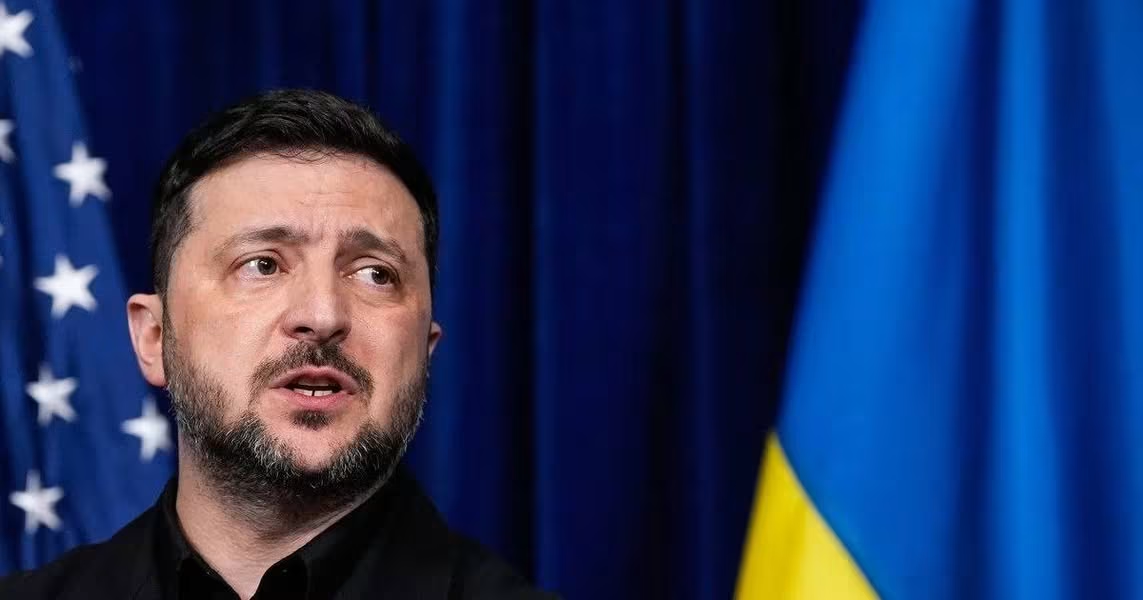
US envoys Steve Witkoff and Jared Kushner met Ukrainian President Volodymyr Zelenskyy in Kyiv on Sunday, September 6, as Washington renewed efforts to negotiate an end to Russia’s war in Ukraine. The visit came one day after the two representatives held more than three hours of closed-door talks with Russian President Vladimir Putin in Moscow.
It was the first visit to Kyiv by Witkoff and Kushner in their roles as US peace negotiators. The two have travelled to Moscow several times for discussions with Russian officials but had not previously visited the Ukrainian capital as part of the current negotiating effort.
The envoys arrived in Kyiv by train and were welcomed by senior Ukrainian officials. Zelenskyy later met them at Sophia Square near the historic Saint Sophia Cathedral in central Kyiv.
Zelenskyy sets out Ukraine’s priorities
Before meeting the US delegation, Zelenskyy said he had held a preparatory meeting with Ukraine’s negotiating team and that Kyiv was ready for substantive discussions aimed at ending the war.
Zelenskyy said, ‘We are interested in bringing the end of the war closer. Peace is needed. Security guarantees are needed. A just and sustainable postwar peace is needed. Our proposals are prepared.’
Ukraine has repeatedly said that any settlement must include strong security guarantees designed to prevent another Russian invasion. Kyiv has also rejected proposals requiring it to surrender territory that remains under Ukrainian control.
Speaking as the US delegation arrived, Zelenskyy said, ‘It is very important that the delegation has arrived here. We have been waiting for Steve and Jared for a long time, and we thank President Trump for allowing them to come. This is important in terms of authorization and in terms of security.’
Zelenskyy said the discussions would take place in two stages. The first involved the Ukrainian leadership and the US representatives, while a second session was expected to include European partners.
National security advisers from Britain, France and Germany were also reported to be in Kyiv on Sunday as European governments remained closely involved in discussions over the terms of any possible settlement.
First round of Kyiv talks concludes
The first round of negotiations between the Ukrainian delegation led by Zelenskyy and the two US envoys concluded later on Sunday. A second round involving European national security officials was expected to follow.
Zelenskyy said, ‘I think we’ll have the opportunity to have extensive discussions with you. One session of talks with us is expected, followed by another session with European partners.’
The discussions focused on possible steps toward ending the conflict, security guarantees for Ukraine and the conditions needed for a lasting postwar settlement. The future of Russian-occupied Ukrainian territory remains one of the largest obstacles to an agreement.
Previous US-backed negotiations have failed to bridge major differences between Moscow and Kyiv. Russia has demanded Ukrainian concessions in the east, including areas of the Donbas that Russian forces do not control, while Ukraine has rejected withdrawing from fortified territory it continues to hold.
Envoys travelled from talks with Putin
Witkoff and Kushner arrived in Ukraine after meeting Putin at the Kremlin on Saturday. Their Moscow talks lasted more than three hours and ended without a major breakthrough being publicly announced.
Putin’s foreign policy adviser Yuri Ushakov described the Moscow discussions as constructive, frank and useful. He said Russia provided the Americans with its assessment of the battlefield and that economic issues were also discussed.
Ushakov said, ‘Economic issues and potentially large, mutually beneficial joint projects for Russia and America were discussed in considerable detail.’
Putin separately described the meeting as ‘highly useful’. A White House official said the talks involved substantive plans for the next steps and that further details were expected to be announced in the coming weeks.
US President Donald Trump had indicated before the Moscow meeting that Washington had a fresh proposal connected to efforts to stop the war, although he did not publicly provide detailed terms.
Peace effort returns to focus
The latest diplomatic effort follows months in which Washington’s negotiations over Ukraine lost momentum. Earlier rounds of US-mediated discussions failed to produce a comprehensive ceasefire or political settlement.
The Trump administration’s attention had also been heavily focused on the conflict involving Iran during the previous six months. The September meetings in Moscow and Kyiv marked a renewed attempt to bring Russian and Ukrainian positions closer together.
Witkoff and Kushner had last been publicly reported meeting Putin in Moscow in January. Kushner, Trump’s son-in-law, has worked alongside Witkoff on several of the administration’s diplomatic initiatives.
Ukraine has sought direct and sustained American involvement, viewing Washington’s participation as important to both negotiations and future security guarantees. Zelenskyy has argued that there is a limited political window for reaching a settlement before attention in the United States increasingly shifts toward its next presidential election.
Temporary pause in attacks on capitals
The diplomatic meetings took place after Russia and Ukraine agreed to temporarily refrain from attacking each other’s capitals. Moscow said it would pause strikes on Kyiv until Monday, while Zelenskyy said Ukraine would also stop attacks on Moscow during the negotiating period.
The arrangement did not amount to a nationwide ceasefire. Fighting continued along the front and attacks were reported elsewhere in both countries while the diplomats were meeting.
The planned travel arrangements for the US delegation had also been affected by the war. Zelenskyy said Russian attacks on Kyiv’s airports prevented the envoys from using an aircraft as originally planned.
Zelenskyy said, ‘Unfortunately, the Russians have shown through their attacks that they cannot use the plane, even though everything was prepared and our airports are operational.’
Ukraine’s airspace has largely remained closed to civilian aviation since Russia launched its full-scale invasion in February 2022. Foreign leaders and senior officials visiting Kyiv commonly enter Ukraine by train from neighbouring European countries.
Attacks continue outside Kyiv
Despite the temporary restraint involving Kyiv and Moscow, Russia and Ukraine continued long-range attacks elsewhere overnight into Sunday. Ukrainian authorities reported casualties in several regions.
Ukraine’s State Emergency Service said Russian attacks killed a 74-year-old man in the Zaporizhzhia region and wounded several other people. An apartment building in the Khmelnytskyi region was also damaged in a drone attack.
Ukraine’s air force said Russia launched 108 drones and several missiles overnight, with Ukrainian forces reporting that they intercepted 82 drones and six missiles.
Russia also reported a large Ukrainian drone attack. The Russian Defence Ministry said its air defences shot down 258 Ukrainian drones over 14 Russian regions, Russian-occupied Crimea and the Black and Azov seas.
Authorities in Russia’s Belgorod region said a Ukrainian drone struck a vehicle, killing a man and seriously wounding a woman.
Ukraine also said it struck the Ryazan oil refinery, about 480 kilometres inside Russia, overnight and reported a fire at the facility. Kyiv has increasingly targeted Russian refineries, oil terminals and other infrastructure in an effort to reduce Moscow’s ability to finance and sustain the war.
Air war intensifies
The diplomatic push comes after an escalation in long-range attacks by both sides. Russia has carried out repeated missile and drone strikes on Kyiv and other Ukrainian cities, while Ukraine has expanded attacks against energy and industrial targets deep inside Russia.
Russia has increasingly deployed fast jet-powered drones that are more difficult for Ukrainian air defences to intercept. Ukraine has also faced pressure on its stocks of US-made Patriot interceptors as Russian attacks have increased.
The ground front, stretching roughly 1,200 kilometres, has seen more limited movement compared with the growing scale of long-range attacks. Both sides continue military operations despite renewed negotiations.
Territory and security guarantees remain key obstacles
Washington’s earlier peace efforts have struggled over several unresolved issues, particularly territory and Ukraine’s long-term security. The Donbas region in eastern Ukraine remains central to the dispute.
Russia wants Ukraine to withdraw from territory in the east that Kyiv’s forces continue to defend. Ukraine has refused, arguing that surrendering fortified areas would weaken the country and leave it vulnerable to another Russian attack.
Kyiv is also seeking binding security guarantees from the United States and European allies. Ukrainian officials say any agreement must provide credible protection if Russia violates a future settlement.
Putin has continued to insist that a settlement must address what Moscow describes as the root causes of the conflict. Russia has also demanded recognition of territorial changes and has long opposed Ukrainian membership in NATO.
Ukraine maintains that any peace must preserve its sovereignty and cannot simply formalise Russian territorial gains without adequate security arrangements.
Diplomatic talks continue in Kyiv
The first round of Sunday’s talks involving Zelenskyy, Witkoff and Kushner ended with no final peace agreement announced. Discussions involving Ukrainian, American and European officials were expected to continue as negotiators examined possible next steps.
The Kyiv meetings follow four and a half years of full-scale war since Russia’s February 2022 invasion. Fighting and long-range attacks remain active even as Washington attempts to restart a negotiating process that has repeatedly stalled over territory, security guarantees and the conditions for a lasting ceasefire.