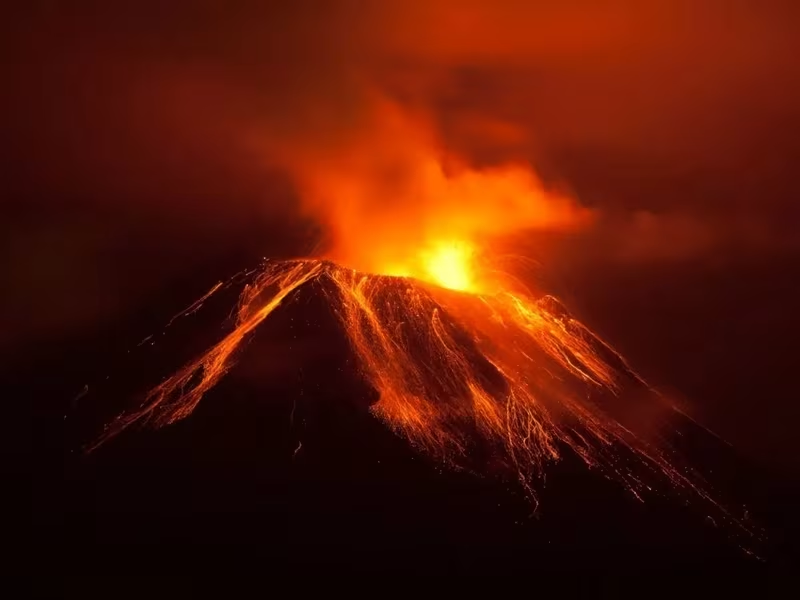
About 170,000 passengers were stranded in Indonesia on Sunday, September 6, after volcanic ash from Anak Krakatau forced authorities to suspend operations at eight airports, including Jakarta’s Soekarno-Hatta International Airport. Indonesia’s Transportation Ministry said 1,558 flights were affected as ash spread across parts of Java, Sumatra and surrounding airspace.
The disruption followed renewed activity at Anak Krakatau, the volcanic island in the Sunda Strait between Java and Sumatra. The volcano had shown increased activity since Friday before producing further eruptions over the weekend.
Authorities reported no casualties from the eruption and did not order an evacuation of nearby communities. Residents and visitors were told to remain at least three kilometres from the active crater.
Eight airports suspend operations
AirNav Indonesia restricted airspace after volcanic ash was detected around major flight routes. Soekarno-Hatta, Indonesia’s busiest airport and its main international gateway, was among the airports forced to stop flight operations.
Jakarta’s Halim Perdanakusuma Airport was also affected. Other airport closures included Radin Inten II Airport near Bandar Lampung and Husein Sastranegara Airport in Bandung.
The suspension at Soekarno-Hatta was extended several times during Sunday as officials continued monitoring the movement and concentration of volcanic ash. Authorities eventually extended the closure until 11.59 pm local time.
By Sunday evening, the Transportation Ministry said disruptions across the eight airports had reached 1,558 flights and affected about 170,000 passengers.
More than 900 of the affected flights were linked to Soekarno-Hatta alone, according to government figures released during the day.
Hundreds of flights hit in Jakarta
Figures changed rapidly as the closure continued. Airport operator InJourney Airports earlier reported 764 affected scheduled flights at Soekarno-Hatta, covering cancellations, delays, diversions and other operational changes.
That figure included 570 domestic passenger flights, 185 international passenger flights and nine cargo services. The Transportation Ministry later said the disruption at the Jakarta airport had grown to more than 960 flights.
Passengers filled terminals while airlines worked to rebook journeys, process refunds and return checked baggage. Travellers were advised not to travel to the airport without first confirming the status of their flights.
Airport management activated its Service Recovery Action protocol and opened an operational command post at Terminal 1B. Food and drinks were distributed to affected travellers, while shuttle buses were arranged to take some passengers to nearby hotels.
Special rest areas were also opened inside the airport. Retail and food outlets in the terminals were asked to operate around the clock while passengers waited for updated travel arrangements.
International airlines cancel services
The eruption disrupted both domestic and international routes. Singapore Airlines, Malaysia Airlines, AirAsia and Lion Air Group were among the carriers that cancelled services to and from Jakarta.
International connections involving Singapore, Kuala Lumpur, Doha, Sydney, Hong Kong, Amsterdam and Seoul were among routes affected during the disruption. Domestic services linking Jakarta with destinations including Bali, Lampung, Surabaya and Makassar were also hit.
Bali’s I Gusti Ngurah Rai International Airport reported more than a dozen cancellations and schedule changes linked to the Anak Krakatau activity. At least five Jakarta-to-Bali flights had been cancelled by 10 am local time.
Flights between Penang and Jakarta were also affected, with six services cancelled and about 1,000 passengers impacted in Malaysia.
Indonesia’s Transportation Minister Dudy Purwagandhi said airports in cities including Semarang and Surabaya had been prepared as alternatives for aircraft that could not land at affected airports.
Ash rises as high as 50,000 feet
Indonesia’s meteorological agency BMKG detected large ash clouds spreading from Anak Krakatau. One plume reached about 20,000 feet, or roughly 6,000 metres, on the Java side of the volcano.
A second plume climbed to approximately 50,000 feet, or about 15,000 metres, over the Sumatra side and parts of Banten province. Ash was also detected over the Sunda Strait and sections of the Indian Ocean west of Sumatra.
The ash spread into parts of Jakarta and Lampung province on the southern end of Sumatra. Satellite monitoring was used to track the plumes and their movement through Indonesian airspace.
Volcanic ash is particularly dangerous to aircraft because fine particles can enter jet engines, damage components and interfere with visibility and other systems. Authorities said the airport closures were therefore required for aviation safety.
Indonesia’s Director General of Civil Aviation Lukman F. Laisa said, ‘Safety remains our top priority in every operational decision.’
Two eruptions recorded on Sunday
Indonesia’s Geological Agency said Anak Krakatau erupted for about 30 seconds at 3.53 am on Sunday. Closed-circuit camera footage showed lava flares from the volcano during the eruption.
A second eruption lasting about 16 seconds was recorded roughly three hours later. The renewed activity followed eruptions and volcanic unrest that had developed from late Friday into Saturday.
Saturday’s activity produced fountains of lava and loud booming sounds. Reports citing Indonesian authorities said the sounds could be heard hundreds of kilometres from the volcano.
Anak Krakatau remained at Alert Level III on Indonesia’s four-level volcanic warning scale. Authorities continued to restrict access around the crater while monitoring seismic and eruptive activity.
No evacuation or casualties reported
Despite the scale of the aviation disruption, officials reported no deaths or injuries directly caused by the latest eruption. No general evacuation order had been issued as of Sunday.
The nearest settlement is more than 16 kilometres from the volcano. Officials nevertheless warned residents, tourists, fishermen and other visitors not to enter the three-kilometre exclusion zone surrounding the active crater.
Some fishing activities were suspended as ash affected coastal areas. School activities were also halted or moved online in some locations because of concerns about exposure to volcanic ash.
Residents in affected areas were advised to limit exposure and use protective masks where necessary. Ash can irritate the eyes and respiratory system, particularly when large amounts settle over populated areas.
Government plans weather modification
Indonesia’s National Disaster Mitigation Agency, BNPB, said authorities planned weather-modification measures intended to encourage rain and clear ash from affected areas.
BNPB chief Suharyanto said, ‘If it rains heavily enough, the volcanic ash that has been disrupting our daily lives since yesterday and continuing today will be washed away quickly.’
Authorities also said there was no imminent tsunami threat linked to the latest activity. Monitoring of Anak Krakatau and the surrounding Sunda Strait remained in place.
Anak Krakatau has a deadly history
Anak Krakatau means ‘Child of Krakatau’ and emerged from the sea during the 1920s inside the caldera created by the catastrophic 1883 Krakatau eruption. The original eruption was one of the most destructive volcanic disasters in recorded history.
The younger volcano has remained active for decades and has repeatedly produced eruptions, lava flows and ash plumes.
In December 2018, an eruption caused part of Anak Krakatau’s flank to collapse into the sea. The collapse generated a tsunami that struck coastal communities along the Sunda Strait and killed more than 400 people in Java and Sumatra.
The 2018 event dramatically changed the volcano’s shape and height. Scientists have continued closely monitoring Anak Krakatau because of its active growth and its position between two of Indonesia’s most populated islands.
Flight recovery depends on ash conditions
Indonesia’s Directorate General of Civil Aviation said it was coordinating with airport operators, airlines, AirNav Indonesia and the country’s meteorological authorities to determine when normal operations could safely resume.
Officials warned that disruption could continue even after airports reopen. Cancelled flights, displaced aircraft, crew schedules and large numbers of waiting passengers can create further delays as airlines rebuild their networks.
Airlines and airport authorities asked travellers to check official flight information before leaving for airports. Passengers with cancelled services were being directed to their carriers for rebooking, refunds and alternative travel arrangements.
As of Sunday evening, eight airports had been affected, 1,558 flights had been disrupted and about 170,000 passengers were caught up in the shutdown. Authorities continued monitoring Anak Krakatau and the movement of its ash clouds before deciding when full flight operations could safely resume.