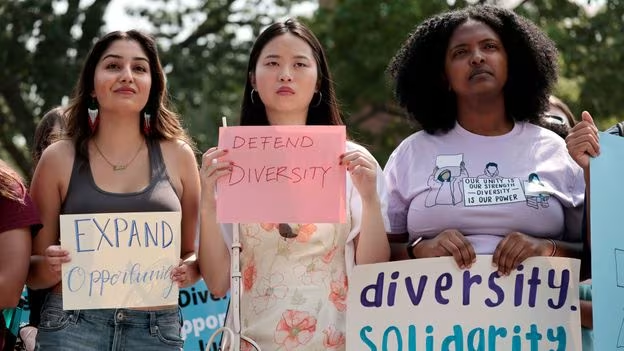
American universities have renamed diversity offices, moved student support into other departments and ended selected programs in response to pressure over diversity, equity and inclusion. Changes at Harvard and the University of Michigan show how institutions have preserved parts of their work while dismantling the offices that previously directed it.
The responses range from new administrative titles to changes in hiring and financial aid. Reporting on Harvard’s restructuring and Michigan’s closures documents different approaches, rather than a single policy adopted across higher education.
Harvard changes office names
By July 2025, at least six Harvard graduate schools had closed or renamed their DEI offices, The Times of India reported, citing The Harvard Crimson. The replacement titles placed greater emphasis on community, belonging and academic culture.
Harvard Divinity School replaced its diversity office with an Office of Community and Belonging on July 1. The Harvard T.H. Chan School of Public Health also adopted the Office for Community and Belonging name.
The public health school announced a working group on constructive engagement to examine viewpoint diversity. These changes show that restructuring can also alter an office’s stated priorities, although a new title alone does not establish how much its daily work has changed.
Michigan moves services and ends its strategy
The University of Michigan announced on March 27, 2025, that it would close its Office of Diversity, Equity and Inclusion and its Office for Health Equity and Inclusion. It also discontinued DEI 2.0, its university-wide strategic plan, Reuters reported.
The university’s presidential office said: ‘Student-facing services in ODEI will shift to other offices focused on student access and opportunity.’
Michigan also ended the use of diversity statements in admissions, promotions, awards and other assessments, following an earlier decision covering hiring. At the same time, it announced increased investment in financial aid, scholarships and mental health support, according to Politico.
Some multicultural student spaces were retained. The combination meant that closing the central DEI office did not end every service previously associated with its work.
Virginia accepts federal oversight
The University of Virginia’s governing board voted to dissolve its DEI office in March 2025. In October, the university reached an agreement with the Trump administration that linked continued federal funding eligibility to changes in its policies.
The agreement required quarterly data submissions through 2028 and acceptance of the Justice Department’s interpretation of unlawful racial discrimination in hiring, admissions and programming. Federal civil rights investigations were paused, with closure dependent on the university completing its planned reforms, Reuters reported.
Court rulings set different limits
The legal position has also changed since universities began announcing closures. In January 2026, the Education Department dropped its appeal of a ruling that blocked its February 2025 guidance threatening federal funding over race-related policies in schools and colleges.
US District Judge Stephanie Gallagher had found that the department’s approach violated free-speech protections and federal procedural requirements. Dropping the appeal left that ruling in place, The Associated Press reported.
A separate case produced a different result on February 6, 2026. The 4th US Circuit Court of Appeals overturned an injunction against President Donald Trump’s anti-DEI executive orders, while leaving room for challenges to specific enforcement actions, according to Reuters.
Those decisions concerned different federal actions. Neither established that all university diversity programs were prohibited or that changing an office’s name resolved questions about its practices.
Tax proposal adds another pressure point
The administration’s latest move targets private institutions’ tax status. A Treasury Department proposal reported by The Associated Press in September 2026 would threaten tax exemptions for private schools and colleges operating programs that give benefits based on race.
The proposal covers areas including admissions, scholarships and campus facilities. As reported, it remained a proposed regulation, with implementation planned after May 2027.